
You walk a property in October for a customer who wants holiday lighting. You look at the roofline, the two big oaks, the walkway, and you make a judgment call about what this person wants and will spend. Then you send your bid over and wait.
Price it high and you lose the job. Price it low and you just sold the cheapest version of a project they would have paid more for. You find out which one happened weeks later, if you find out at all.
Packages fix that. Every contractor I talk to already knows it. Yet almost none of them run packages, and the reason is always the same: building the options by hand is miserable. Offering three tiers means building three sets of line items. If the customer picks the middle one, someone has to rebuild the estimate from scratch.
The fix isn’t a faster estimate. It’s showcasing every option at once and letting the customer choose.
It looks like this: you load every item the customer might want onto one estimate — roofline, trees, walkway, wreaths, timer, takedown, storage — and mark which package each one belongs to. Silver, Gold, or Platinum, for example, with add-ons sitting next to them. Only one link goes out.
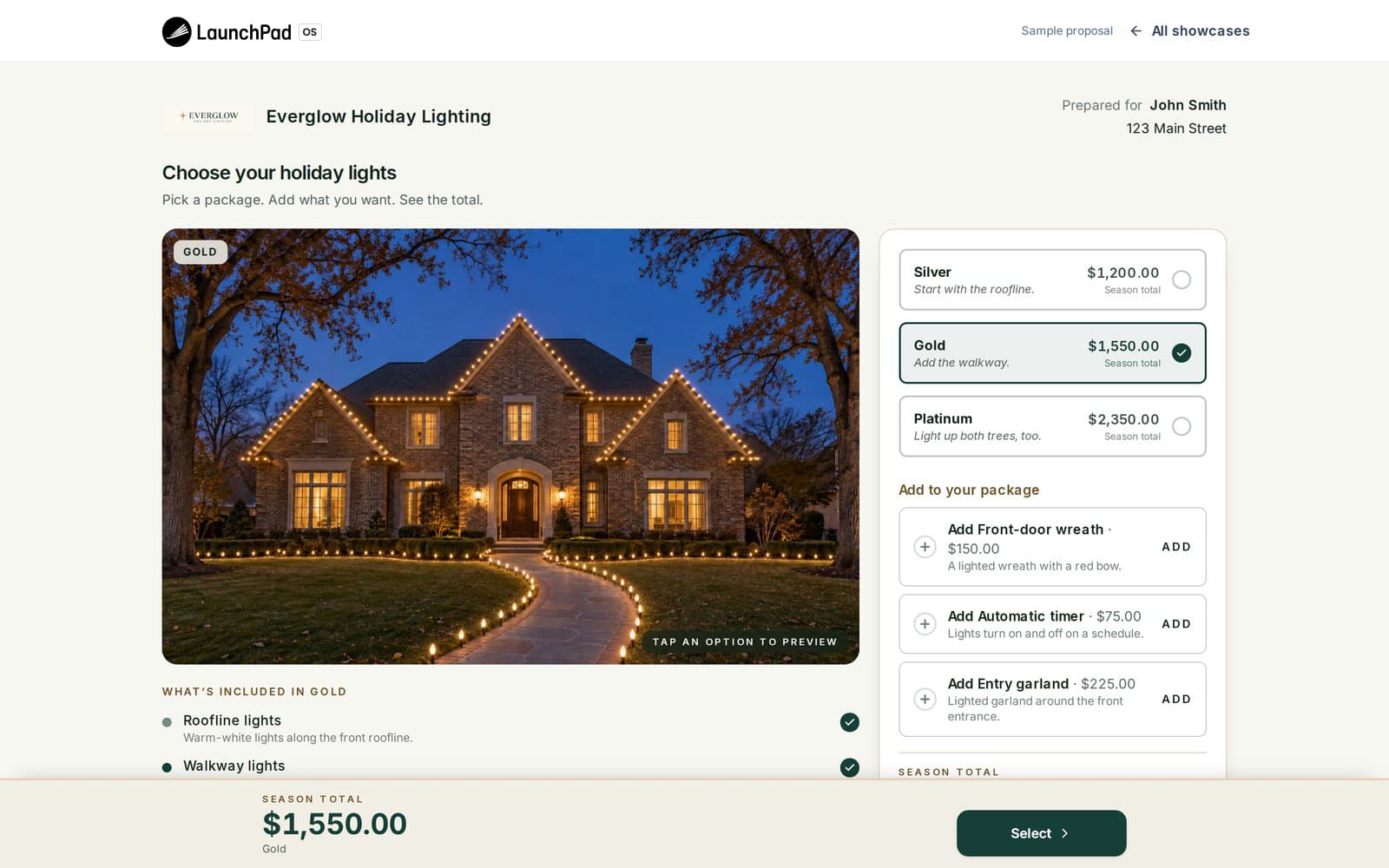
Now the customer is the one making decisions. They open it on their phone, see what you’re proposing, and start picking. The price moves as they click. They add both oaks, drop the wreaths, add the timer, and see exactly what each choice does to the total — the same way they buy everything else in life online. And when they’re ready, they e-sign and pay on that very same page.
See what your customer sees. Open a sample Showcase proposal, compare the packages, and watch the total move as you click.
Here is the part that matters to your office. When the selections are saved upon checkout, everything the customer didn’t pick comes off the estimate, as well as the total. The estimate finalizes at the amount of the selected work and converts automatically into a job. Nobody has to retype it or rebuild it. And the job your crew runs in November matches the proposal the customer built in October exactly.
This type of experience changes what a proposal is — for you and your customer. It stops being your best guess at their wants, needs, or budget and becomes the place where they tell you, by clicking, exactly what they wanted.
Fifteen years in this industry taught me that the proposal is where the job is won or lost, and it is the one place that existing software never helped. Rather, it printed what you typed. That’s it.
That’s why we built it into LaunchPad OS. We call it the Showcase.
Holiday lighting is where you will see it fastest. But it works across every service you sell. You’re already selling tiers, whether or not you call them that. Let the customer see all three.
Before you build this season’s packages, pick one yourself.
Sample business, sample prices. No payment is taken.

Drew Wagner is CEO and founder of LaunchPad, the company behind LaunchPad OS: the system of intelligence for lawn care, landscaping, artificial turf, snow & ice, and pest & mosquito operations, built on an agentic AI foundation. He has spent fifteen years in the green industry as an operator, technology executive, and product founder.